


Will welfare checks improve conditions on fur farms?
发布时间:2016-10-19 编辑:查字典英语网小编
Across Europe, the fur industry is preparing to introduce a new set of welfare assessments for the animals in its care.
It hopes to reassure consumers who might otherwise shun its products. But how far do the new measures go, who is monitoring them and what reassurance do they really offer?
In a long metal shed, hundreds of light brown mink dart around within rows of wire cages. It's really quiet - only the occasional squeak can be heard.
The fate of these animals is ultimately the same as any other farmed mink. At six months old, they will be gassed and their pelts sent to auction.
But for now, these ones are being studied by researchers working on new animal welfare assessments for the fur industry.
The mink are kept at a fur farm belonging to Aarhus University in Denmark. The senior scientist, Steen Moller, showed me around one of the sheds.
"Like all other farm animals, they are kept in a confined space, so what we need to investigate is how do we provide the best environment for them," he says.
The cages contain shelves, straw and "toys" (plastic tubes), which are enrichments required by Danish law. Legal requirements vary from country to country, but Mr Moller is working on a common set of welfare assessment measures which can be applied to all European fur farms that sign up to be inspected.
"Basically, a farm will have three visits in one year in order to get an assessment," he says.
"If they have all of the provisions for the animals in terms of cages and enrichments and they feed them well and take care of them well, then they will get a good score. Any farm starts with score zero and then they get scores for everything they do. The best score they can get is 100, but I don't think anyone will get 100."

Image captionStraw, shelves and plastic tubes are required by Danish law

Image captionTwo animals are kept in each cage which is around 90cm long and 30cm wide

Image captionMink are presented with a stick to see how they react
The "Welfur" assessments, as they are known, will look at housing and management conditions, but also observe how the animals themselves seem to be doing.
One of the tests involves putting a stick through the bars of the cage. Inquisitive mink that approach it are seen as well adjusted. Any that back off and appear fearful are considered likely to be living in stress.
'We ask the animal what they want'
In another room, a specially adapted cage includes a nest box, food, a running wheel and swimming water. Pressing the right lever allows access to each of these resources. Observing how often mink are prepared to press each lever to access different parts of the cage is used to measure the animal's preferences.
"They are quite good learners, says Mr Moller's colleague, Jens Malmkvist, "so in that way, we can say we ask the animal what they want instead of what we think they want.
"The nest box - they want to work for this permanently. They will work for access to swimming water and they will work for access to a running wheel - however, on a low level, so maybe this is more like a luxury thing. It is a 'nice to have' rather than a 'need to have'."

Image captionA mink emerges from its nest box
Those conclusions, based on various scientific studies, might seem rather convenient for the fur industry. Nest boxes are already attached to cages on mink farms. Adding running wheels or access to swimming water would be harder and more costly.
"We have done a lot of studies on other things that are easier to give them, like permanent access to straw or a shelf or something to play with," says Mr Malmkvist.
"The resources in the cage do matter for them, so we don't decide what they should have, but we try to provide some knowledge - if you have to enrich the cages, which things should you do first?
"And then, swimming water is not in the front line. It would be enriching for mink probably, but it's not the first thing to do if you have to invest in cages."
Farms which have resources that mink appear to value most in scientific studies will score well under the "Welfur" scheme. Lesser scores are given for enrichments that are not so highly valued or are considered unproven.

Image captionHundreds of mink are kept in each shed
Voluntary scheme
The new welfare inspections are due to start in January 2017. They will cover the three main fur animal species farmed in Europe - the mink, the blue fox and the silver fox.
Fur Europe - the trade association behind the scheme - says an independent company is being used to conduct the checks.
Farmers will have to pay towards the cost of their assessments, but taking part is voluntary.
"It is voluntary, yes, but to which extent, you can discuss," says Mette Lykke Hansen, Fur Europe's chief executive.
"We have had a statement from the European auction houses saying that from 2020, they will not sell skins that are not Welfur certified, so if you are not in the system, it will be very difficult to sell your skins from 2020 and onwards."
If any farm that opts for an assessment fails to reach an acceptable welfare score, it will also be unable to sell its furs at European auction houses, according to Fur Europe.
It does not intend to publish each farm's score - individual farmers can choose to do that if they wish. Instead, it says it will publish only aggregated data, possibly for each country.

Image captionThe fur farmer Ceslovas Tallat-Kelpsa on one of his farms in Lithuania
The fur farmer Ceslovas Tallat-Kelpsa does plan to sign up. He keeps more than 200,000 mink on his farms in Lithuania. He thinks it will improve animal welfare standards and make European furs more competitive, boosting the price he is paid for his pelts.
"I believe it will increase," he says. "Buyers want to buy certificated fur."
He told me that in 2015, the price paid per pelt barely covered his production costs. He received an average of €30 (£26) for each one, when previously he had been paid about €70 (£61) on average.
'Abhorrent product'
The fur industry is keen to convince people it is doing all it can to look after the animals in its care, but its Welfur scheme does not convince everyone.
"I have come to the conclusion that it is very little more than a PR lobbying tool to try and defend the fur industry, mostly within the European Union," says Mark Glover from Respect for Animals, which campaigns against the international fur trade.
"The criteria are economic. A mink cage, for instance, will never be longer than a person's arm, for obvious reasons of catching and handling the mink.
"They are incapable of making conditions anywhere near acceptable for the animal welfare of the mink and that is where we disagree with them entirely. Fur is an abhorrent product and the sooner it is banned, the better."
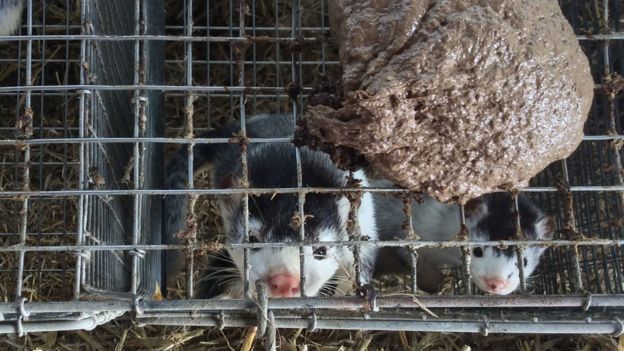
Image captionFood is a paste squirted on top of each cage at this mink fur farm in Lithuania
Fur farming was banned in England and Wales by the Fur Farming (Prohibition) Act 2000. At the time, there were 13 fur farms in England and none in Wales. Similar bans followed in other parts of the UK. The import and sale of fur skins and products is permitted.
Mink is the animal most commonly bred for its fur in Europe, where the biggest producer is Denmark. It produced 17.8 million mink skins in 2015, according to industry data from auction houses where the skins are traded.
Fur trims have become popular on garments, but the pelts are also used for other products including scarves, hats, cushions, key rings and coats.

Image captionHats made using mink fur
Fashion designers such as Stella McCartney have refused to use real fur. Others have opted to use artificial "faux" fur instead. But real fur continues to appear on catwalks across Europe.
"I agree that it is not necessary," says fur farmer Ceslovas Tallat-Kelpsa, "but in my mind it is a good product, very natural, very ecological. I think we are doing everything in the best way we can."

- HIV life expectancy 'near normal' thanks to new drugs 研究发现新药物可使艾滋病毒携带者预期寿命“接近正常”
- 和“英式下午茶”有关的英语表达
- The power of colour 色彩的魅力
- All over the shop 到处都是
- Statins and 105-year-old worker 他汀类药物测试、仍坚持工作的105岁老人
- Perpendicular 和 vertical 的区别
- 英语里“pink 粉红色”的含义
- Not half 加强肯定语气的表达“非常”
- 英国餐桌礼仪小常识
- London City first in UK to get remote air traffic control 英国首个远程空中交通管制系统
- Russia and the West: Where did it all go wrong?
- Brryan Jackson: My father injected me with HIV
- Will welfare checks improve conditions on fur farms?
- 在伦敦的大学
- Philip Hammond: Chancellor Brexit delay claims denied
- 你能听懂英语广播里的词汇吗2
- 适合英国留学的5个城市
- 虚拟现实会成为现实吗?
- 阿富汗军队反攻塔利班
- Japan PM Abe sends ritual offering to Yasukuni shrine for war dead
- 英语视频
- 练习6_第三课时(二等奖)(苏教版五年级上册)_T1465483
- 外研版英语三起5年级下册(14版)Module3 Unit1
- 019牛津上海版英语高二上册 Unit 5 Technology all around us教学课堂实录视频+PPT课+教案,安徽省
- 冀教版小学英语四年级下册Lesson2授课视频
- 练习4_第三课时(市一等奖)(苏教版四年级上册)_T1457510
- 005牛津上海版英语高二上册 Unit 5 Technology all around us教学课堂实录视频+PPT课+教案,上海市
- 七年级下册外研版英语M8U2reading
- 牛津上海版三年级英语上册Module 3 Unit 3 In the park
- 015牛津上海版英语高二上册 Unit 4 Big businesses教学课堂实录视频+PPT课+教案,上海市
- 12 ie üe er_第一课时(二等奖)(苏教版一年级上册)_T491704
苏教牛津版英语三下 备课
苏教牛津版英语一下《unit4》教学设计3
苏教牛津版英语一下《unit2》教学设计3
苏教牛津版英语四下《unit 4 Buying fruit》教学设计
苏教牛津版英语四下 全册教案——6
牛津苏教六下《Unit 2 More exercise》word教案2篇
苏教牛津版英语四下《Unit 1》教学设计2
苏教牛津版英语四下《unit 6》教学设计
苏教牛津版英语四下《Unit 1 A new student》教学设计
苏教牛津版英语四下《5B U1(A)》教学设计
苏教牛津版英语一下《unit5 Lesson2》教学设计
苏教牛津版英语一下《unit3》教学设计1
苏教牛津版英语四下 全册教案 3
牛津苏教六下《Unit 3 Asking the way》word教案3篇
苏教牛津版英语四下《Unit 1》教学设计3
苏教牛津版英语四下《Unit 2 At a party》教学设计
牛津苏教版英语四下《Unit 7 What s the matter》练习题
苏教牛津版英语四下 全册教案3
苏教牛津版英语一下《unit3》教学设计3
苏教牛津版英语三下《Unit 6》教学设计3
苏教牛津版英语一下《unit5》教学设计1
苏教牛津版英语三下《unit8》教学设计1
苏教牛津版英语四下《Unit 5 》教学设计1
苏教牛津版英语四下《Unit 5》教学设计2
苏教牛津版英语三下《Unit 4》教学设计
苏教牛津版英语四下 全册教案
苏教牛津版英语四下《Unit 2》教学设计1
苏教牛津版英语一下《unit4》教学设计1
苏教牛津版英语一下《Unit8 I can swim》教学设计3
苏教牛津版英语三下《Unit5 Plus and minus A and C》教学设计
- 年级
- 类别
- 版本
- 上下册
- 年级
-
不限
- 类别
-
英语教案 英语课件 英语试题 不限
- 版本
-
不限
- 上下册
-
上册 下册 不限